 ultimate-guide
How to Identify High Quality Vintage Clothing (2026 Guide)
Table of Contents
- Start With Fabric: The Vintage Fabric Identification Guide
- How to Spot Authentic Vintage Tags and Labels
- Stitching, Seams, and Garment Construction
- Hardware Check: Zippers, Buttons, and Clasps
- Leather Quality and Tanning Methods
- The Vintage Clothing Grading Scale for Resellers
- Digital Authentication Tools and Regional Manufacturing History
- Care and Preservation After You Buy
- Frequently Asked Questions
Last Updated: September 20, 2026
Start With Fabric: The Vintage Fabric Identification Guide
Fabric is the fastest way to sort high quality vintage from filler. Before you check a tag or a zipper, run your fingers across the cloth and ask one question: does this feel like it was made to last? This guide walks through the checks we use when grading incoming lots, and it starts where most resellers stop looking.
Natural Fibers vs. Synthetic Materials
Natural fibers, including cotton, wool, linen, and silk, tend to age in predictable ways. They soften, pill, and fade rather than melt or shine. Synthetic materials like polyester, nylon, and rayon often hold color longer but develop a slick, plasticky hand that never improves with age. A common mistake is assuming "old" means "natural." Plenty of 1970s and 1980s garments are pure polyester, and they are not the pieces your customers are hunting for.
- Cotton: matte surface, cool to the touch, wrinkles and creases sharply
- Wool: springy, resists creasing, smells faintly of lanolin when damp
- Linen: dry and crisp, wrinkles hard, shows fiber slubs
- Polyester: smooth, slightly warm, holds a crease pressed in with a fingernail
The Burn Test and Fiber Content Clues
The burn test is a destructive check, so only use it on a loose thread or an inside seam allowance, never on a visible surface. Pull one thread, hold it with tweezers over a fire-safe surface, and light it.
- Cotton and linen: burn like paper, smell like burning leaves, leave soft gray ash
- Wool and silk: smell like burning hair, self-extinguish, leave a crushable black bead
- Polyester and nylon: melt and shrink away from the flame, smell chemical, leave a hard plastic bead
How to Spot Authentic Vintage Tags and Labels
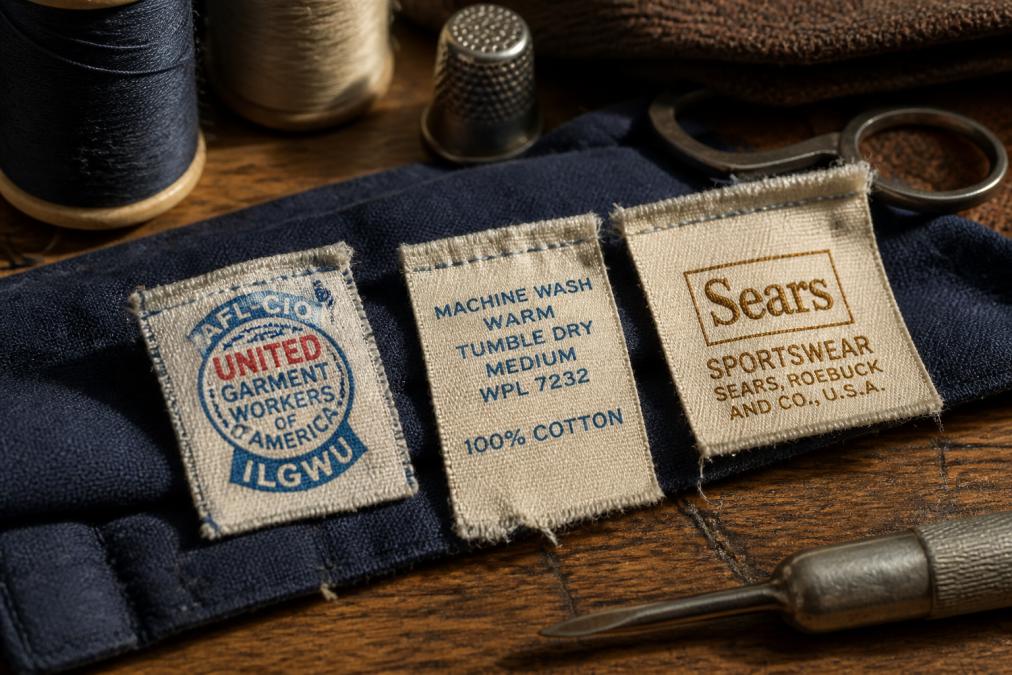
Authentic tags are the paper trail of a garment, and they are the single most counterfeited detail. A reproduction can copy a silhouette, but it rarely copies a 1960s union label, the exact typeface of a department store brand, or the fiber content wording of its era. Check the tag first, then verify it against the construction.
The Four Label Types You Will Actually Encounter
Most vintage garments carry more than one label, and each type tells a different part of the story:
- Brand or maker label: the main label at the back of the neck. Woven labels (threads interlaced into the fabric) generally predate printed labels (ink on a fabric or satin base), so a woven label on a garment with a modern cut is a red flag.
- Union label: stitched into a side seam or hem by garment worker unions. The wording, color, and layout changed across decades, so the specific union name and print style date a piece to a window rather than a single year.
- Fiber content label: required by the Federal Trade Commission guidance on textile fiber content labels. Older labels use phrasing and abbreviations modern manufacturers no longer print, which is one of the easiest authenticity tells.
- Care label: became standard in the 1970s. A garment with no care label but a convincing 1950s cut is not automatically suspect, the absence is era-consistent.
Dating a Garment From Its Label Anatomy
You do not need a price guide to narrow a piece to a decade. Work through these markers in order:
- Print method: woven labels predate printed ones. Satin-printed labels with sharp, glossy ink skew later than matte woven labels.
- Typeface: serif and script faces dominate earlier decades; clean sans-serif faces skew later. Compare the letterforms against other labels from the same brand, not against modern fonts.
- Country of origin phrasing: the printing style and wording shift by decade and by region, and the phrase itself is a dating clue.
- Size numbering: numeric sizing (a single number like 12 or 38) generally predates the S/M/L letter sizing that became common later.
- Care instruction wording: early care labels use terse, symbol-light language; later ones add symbols and longer instructions.
Internal Consistency Is the Real Test
A tag is only evidence if it agrees with everything else. Run these cross-checks:
- A tag claiming "100% wool" on a garment that feels slick and shiny is a mismatch, trust your hands.
- A woven brand label paired with a modern plastic zipper is a mismatch, trust the hardware.
- A union label stitched with synthetic thread on a garment with serged (overlocked) seams is a mismatch, trust the construction.
Digital Cross-Checking Before You Commit Capital
Most guides stop at the tag. The modern edge is verifying it. Reverse image search on a label photo, online label and maker's-mark archives, and reseller community databases let you match a tag against documented examples before you buy. Photograph the label, the hardware, and the inside seams, then search all three. A label that appears nowhere in any archive is not automatically fake, but it is a reason to slow down.
Stitching, Seams, and Garment Construction
Construction quality is where high quality vintage separates itself from thrift store finds. Turn the garment inside out. What you see on the inside tells you more than the outside ever will.
Hardware Check: Zippers, Buttons, and Clasps
Metal zippers are the tell. A vintage garment with a smooth-running metal zipper, a branded pull tab, and clean teeth is almost always a better piece than one with a plastic zipper that catches. Check for:
- Zipper brand and era: metal zippers with engraved pulls date to specific decades
- Buttonholes: hand-worked buttonholes have slightly uneven edges; machine ones are uniform
- Sturdy clasps: hooks, eyes, and snaps should seat firmly with no play
- Corrosion: rust or green residue on hardware means moisture damage, which usually spreads to the cloth
Leather Quality and Tanning Methods
Vegetable-tanned leather ages into a patina. Chrome-tanned and bonded leather do not. Bonded leather is shredded leather fiber glued to a backing, and it peels and cracks rather than softening. On a leather jacket, press a thumbnail into the surface: vegetable-tanned leather shows a temporary mark that fades, while bonded leather shows nothing or flakes. Look at the edges too.
The Vintage Clothing Grading Scale for Resellers
Grading is how you turn a pile into inventory, and it is where most guides go soft. A grade is only useful if it means the same thing to you, to your buyer, and to the platform the buyer found you on. We use a five-tier scale when sorting wholesale lots.
| Grade | Condition | Typical Use |
|---|---|---|
| Mint | Deadstock, unworn, tags attached | Premium listings |
| Excellent | No flaws, minimal wear | Core inventory |
| Good | Minor wear, sound structure | Everyday resale |
| Fair | Visible flaws, still wearable | Bargain bins |
| Poor | Damage or missing parts | Repair or salvage |
What Separates Each Grade in Practice
The table is the shorthand. The grade is the discipline. Here is what actually moves a piece down a tier:
- Mint to Excellent: the drop is wear, not damage. Faint underarm discoloration, a softened collar, or a missing original belt moves a deadstock piece to Excellent even if it looks unworn on a hanger.
- Excellent to Good: the drop is a disclosed flaw. A single small stain, a replaced button, or light pilling that a buyer would notice on arrival belongs in Good, not Excellent.
- Good to Fair: the drop is structural. A weakened seam, a stuck zipper, or a repair that changed the silhouette means the piece is wearable but not dependable.
- Fair to Poor: the drop is function. If the garment cannot be worn as-is without a repair, it is Poor regardless of how it photographs.
Grade Against the Standard, Not Your Mood
The gap most resellers fall into is grading by how a piece feels on a good sourcing day. Two habits close it:
- Write the flaw down before you grade. If you cannot name the flaw in one sentence, you have not inspected closely enough to grade.
- Grade the worst feature, not the average. A garment with one visible flaw and nine perfect details is a Good piece, not an Excellent one. Buyers grade on the flaw.
Why Consistent Grading Is a Margin Strategy
Deadstock, meaning unsold original stock, sits at the top because it carries the strongest provenance. But provenance only converts if your grade holds up on arrival. A reseller who grades consistently builds trust, and trust is what turns a one-time buyer into a repeat customer. The reverse is also true: one over-graded piece costs you the review, the return shipping, and the customer.
Digital Authentication Tools and Regional Manufacturing History
Two angles most guides skip are worth your time. First, digital authentication tools: reverse image search, label databases, and online archives let you match a tag or a maker's mark against documented examples before you commit capital. Second, regional manufacturing history explains why a garment was made the way it was. A piece produced in a region with a strong textile tradition often shows construction techniques that a mass-market factory never used.
Care and Preservation After You Buy
Preservation protects the margin you just earned. Store natural fibers on padded hangers in a cool, dark space, and keep wool and silk away from direct sunlight to slow fading. Fold knits rather than hanging them, since a hanger stretches the shoulders. Wash only when necessary, and follow the care label when one exists. For leather, condition sparingly and keep it away from heat.
Frequently Asked Questions
Which vintage brands are worth money?
Brands like Levi's, Chanel, and Hermès hold value, but high quality vintage isn't only about the label. Look for natural fibers such as silk or vegetable-tanned leather, French seams, metal zippers, and sturdy clasps. Pieces from the 1950s-1970s with minimal wear and original tags often sell higher. Regional manufacturing history can also add value, like American-made denim or Italian leather goods.
What is the 3-3-3 rule for clothing?
The 3-3-3 rule is a styling guideline: 3 colors, 3 textures, and 3 patterns maximum in one outfit. It helps create balanced looks. For vintage resellers, it's a useful framework when photographing and styling inventory to show customers how pieces mix. It's not a quality test, but it can guide how you present high quality vintage items in listings.
What's the difference between vintage and true vintage?
Vintage generally means at least 20 years old, while true vintage refers to pieces from the 1920s through the 1970s, often with distinct construction like hand-stitched hems and metal zippers. True vintage usually has higher material integrity and craftsmanship details. Reproduction items made later may look vintage but lack the original tags and hardware that signal authenticity.
How can you tell if vintage clothing is high quality?
Check the fabric first: natural fibers like cotton, wool, silk, and linen often outperform synthetics in durability. Inspect stitching for double seams, French seams, and even thread tension. Look at hardware: metal zippers and sturdy clasps last longer than plastic. Also examine the lining quality and buttonholes. A vintage clothing grading scale can help you categorize condition and spot flaws before buying.